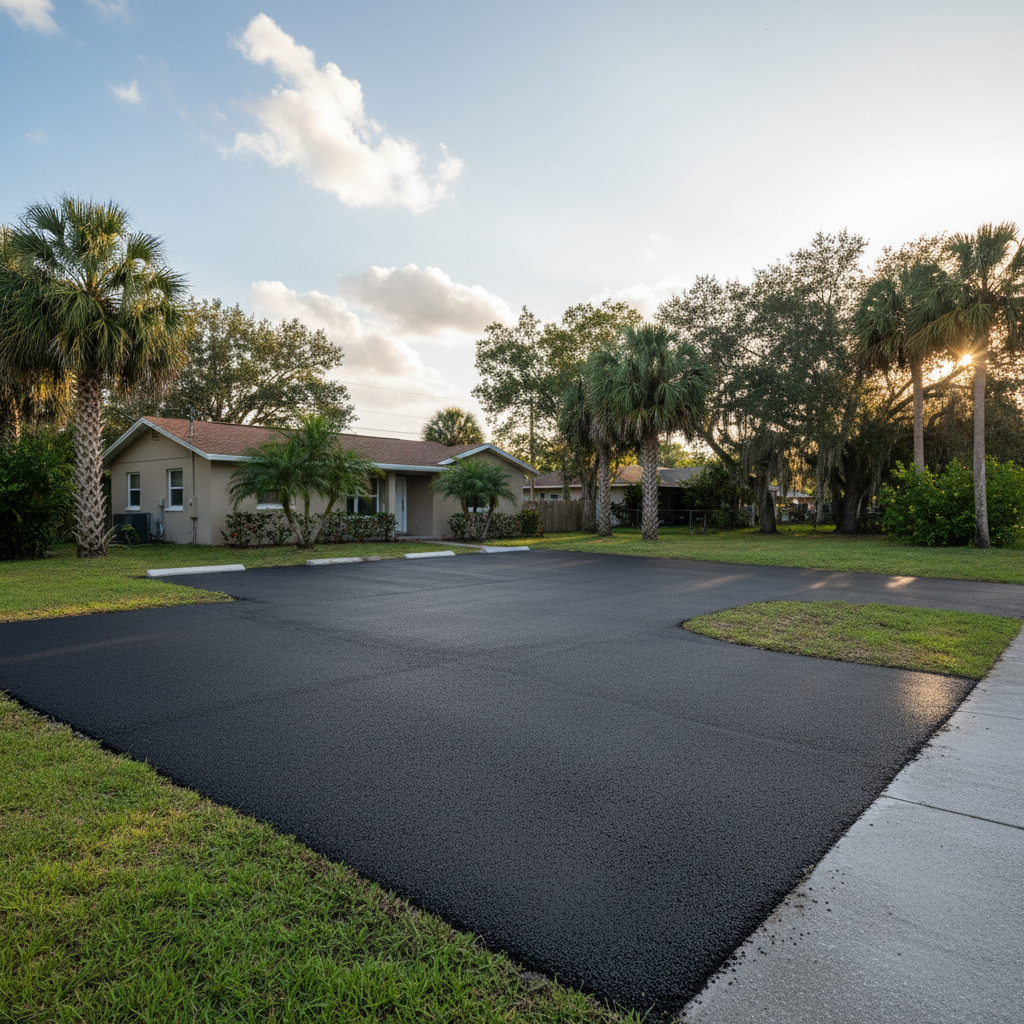
So, you're thinking about getting some asphalt work done for your business property right here in Daytona. Maybe it's a brand-new parking lot, a complete repave, or just some serious patching. The first thing on your mind, naturally, is probably, "How much is this going to cost me?" That's a fair question, and honestly, I get asked it all the time.
A commercial asphalt project is a whole different animal compared to a residential driveway. We're talking more regulations, heavier traffic loads, and usually a much bigger scope. All that means the pricing structure is different too. Let's dig into what you can expect.
What Makes Commercial Asphalt Pricing Tick?
You know the drill: no two jobs are exactly alike. But when it comes to commercial asphalt, a few big factors really drive the cost.
- Project Scope & Size: This is the biggest one, plain and simple. Fixing a small access road will cost way less than building a brand-new 200-space parking lot. We're looking at square footage, sure, but also how deep the asphalt needs to be, how many layers we're putting down, and how much prep work the ground underneath needs. Bigger jobs mean more materials, more labor, and more equipment hours.
- Existing Conditions: Are we putting down asphalt on fresh, untouched soil, or are we tearing out an old, crumbling lot? If we have to mill and remove existing asphalt, or stabilize a soft sub-base — which, let's be honest, can be a real headache with our sandy soil and high water table in spots like Ormond-by-the-Sea — that adds a significant chunk to the price. Got drainage issues? We need to fix those right, or your new lot won't last.
- Asphalt Thickness & Mix: Commercial lots have to handle heavier vehicles than your average car. We're not just talking about delivery trucks; sometimes it's dumpsters, forklifts, or even emergency vehicles. This means we need thicker asphalt layers and often a tougher, higher-grade asphalt mix. A typical commercial parking lot might need 3-4 inches of asphalt, sometimes more, depending on how much traffic you expect.
- Site Accessibility: Can our big paving equipment get in and out easily? Are there tight corners, low-hanging obstructions, or limited spots to stage our materials? Tricky access can slow down the crew and, yep, increase labor costs.
- Permits & Regulations: Commercial projects often need permits from the city or county. There might be specific ADA compliance rules for parking spaces and ramps, stormwater management plans, or even particular material requirements. These aren't just extra steps; they can make the project more complicated and add to the overall cost.
- Striping & Markings: Don't forget the finishing touches! Parking space lines, directional arrows, handicap symbols, fire lanes — we paint all these on. The more complex the layout, the more time and paint it takes.
Typical Cost Ranges for Commercial Asphalt in Daytona
Okay, I know you want numbers, not just a list of factors. Keep in mind these are broad ranges for our area, and your specific project will get a precise quote. But this should give you a good idea.
For a full-depth new asphalt installation (that means we're building it from the ground up, including getting the base ready), you're generally looking at $5.00 to $9.00 per square foot. This covers excavation, grading, base material, and 3-4 inches of asphalt. For really heavy-duty applications, it could push higher, of course.
If we're talking about an asphalt overlay (that's paving new asphalt over an existing, but still solid, asphalt surface), that's usually less, somewhere in the range of $2.50 to $5.00 per square foot. This assumes the existing surface is stable enough to support the new layer and doesn't need a ton of patching beforehand.
For milling and repaving (removing a few inches of old asphalt, then putting down new), you're probably looking at $3.50 to $7.00 per square foot. This is a great choice for lots that are showing significant wear but still have a good base underneath.
Patching, crack filling, and sealcoating are usually priced by the square foot or linear foot for cracks, but they're much less per square foot than a full pave. Sealcoating a commercial lot, for example, might run you $0.25 to $0.50 per square foot, but that's a maintenance item, not a construction one.
What Your Quote Should Include
When you get a quote from a good company like Allied Asphalt Contractor, you shouldn't have to guess what's covered. A clear quote will break down the costs. Here's what you should expect to see:
- Site Preparation: This means grading, digging, removing old material, and compacting the base.
- Materials: Specific details on the type and thickness of the aggregate base, and the type and thickness of the asphalt mix.
- Labor: The cost for the crew and equipment to do the work.
- Equipment: Sometimes it's listed separately, sometimes it's part of labor/materials, but it's always there.
- Traffic Control: If needed for safety during the job.
- Permits & Inspections: Who is responsible for getting them and paying the fees.
- Cleanup & Disposal: What happens to the old material.
- Striping & Markings: If included, what kind and how many.
- Warranty: What kind of guarantee they offer on their work.
How to Avoid Overpaying
Nobody wants to get ripped off. Here's my advice for making sure you get a fair deal without sacrificing quality:
- Get Multiple Quotes: This is a no-brainer. Three quotes from reputable, licensed, and insured contractors will give you a good sense of the market rate for your specific project.
- Compare Apples to Apples: Make sure each quote details the exact same scope of work. If one quote is significantly lower, find out why. Are they using less material? Skipping a critical prep step?
- Check References & Reviews: Don't just take their word for it. Call past commercial clients, check their online reviews. See if they've done similar work in Daytona.
- Ask About Experience: How long have they been doing commercial asphalt? Do they specialize in it? You definitely want a crew that knows what they're doing.
- Understand the Warranty: A good contractor stands behind their work. Make sure you understand the terms of their warranty.
- Don't Go for the Cheapest Bid Automatically: The lowest price often means cutting corners. For a commercial property, that can lead to costly repairs down the road. You're making an investment; you want it to last.
Investing in your commercial property's asphalt isn't just about looking good; it's about safety, accessibility, and projecting a professional image. Do your homework, ask the right questions, and you'll get a durable, long-lasting surface that serves your business well for years to come.